
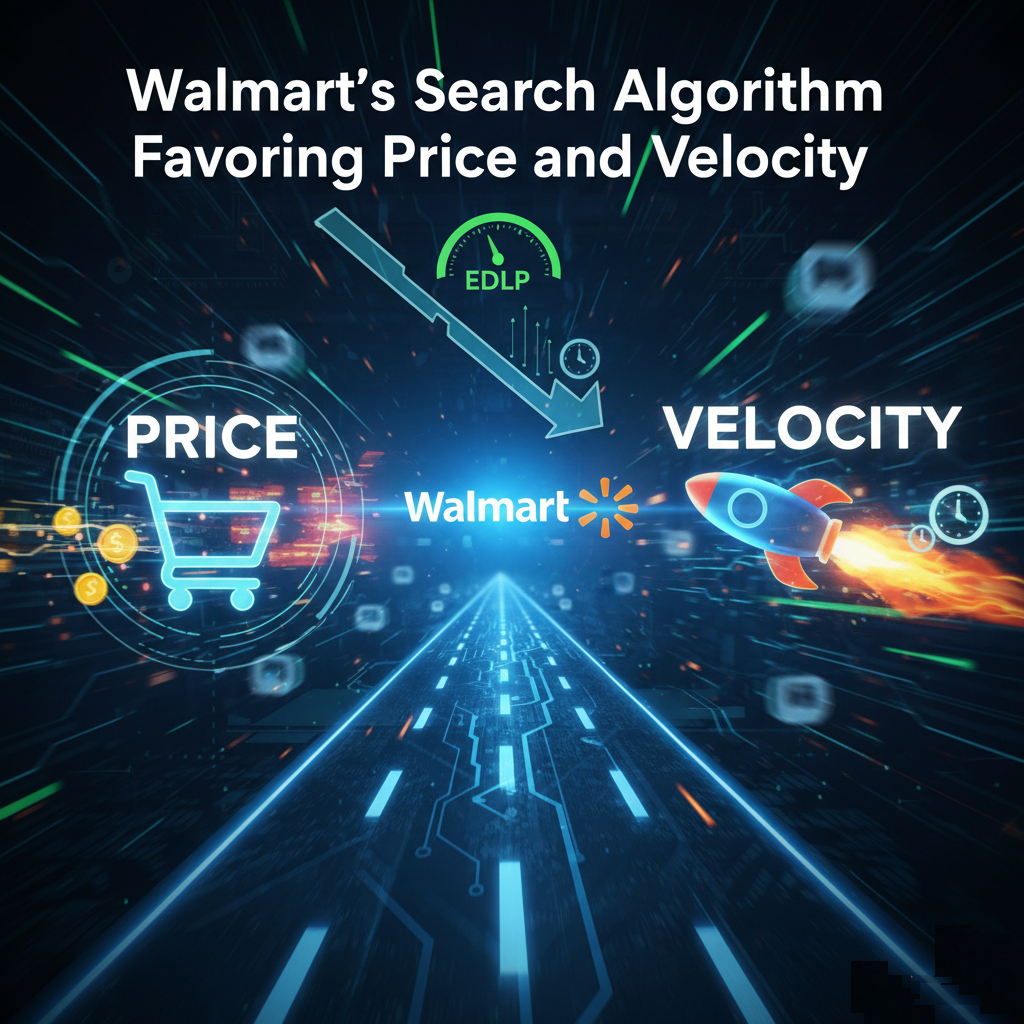
Walmart, the retailing colossus, is not merely a brick-and-mortar giant; it is a burgeoning e-commerce powerhouse.
If you are selling online, particularly through one of the most popular e-commerce platforms, understanding the mechanics of the Walmart Marketplace is an imperative, not an option.
For many brands, the question of high-level visibility on this platform boils down to one critical insight: Is the Walmart search algorithm truly favoring just price and velocity?
Walmart’s search algorithm example: A product priced 10% lower than Amazon with 5 sales per day will outrank a higher-priced item with perfect images but zero velocity—proving the algorithm’s ruthless focus.
The answer is a resounding “yes,” and for sophisticated sellers, this knowledge is gold. Consider this: In the highly competitive world of online retail, where do shoppers turn first?
Often, it is to giants like Amazon or Target, but the growing presence of Online Walmart is rapidly shifting consumer habits.
Therefore, mastering the search ranking factors on Walmart’s platform—the invisible hand guiding customers to your products—is the ultimate determinant of marketplace success.
Many Amazon seller veterans try to apply old strategies, but the Walmart system, in fact, operates on a fundamentally different ethos, one rooted deeply in its history as a value-driven retailer.
Consequently, a distinct and specialized Walmart SEO strategy must be adopted. The core of the Walmart algorithm’s decision-making process is, surprisingly, less complicated than its rival’s, yet ruthlessly efficient.
It places a monumental premium on two variables: low price and high sales velocity. This simple equation reflects the corporate DNA of Walmart itself: Everyday Low Prices (EDLP).
To an algorithm, velocity signifies customer satisfaction and product relevance.
When a product is competitively priced and sells quickly, the system receives undeniable proof that this item is providing value and should be promoted to the top of the search results.
Why Price Remains King at Walmart
The concept of price being a primary ranking factor for Walmart is intrinsic to its brand identity.
It’s what drives shoppers to both the physical stores—perhaps the ones near me with Walmart hours—and the growing Online Walmart experience.
For a third-party seller, this means the pressure to maintain a razor-sharp, competitive price point is constant.
In fact, the price on your Walmart listing is often benchmarked against the same product sold on other top ecommerce platforms, especially Amazon.
If the Walmart algorithm detects a significantly lower price elsewhere, your listing may be suppressed or even delisted, a policy known as the “Price Parity Rule.”
- The Low-Price Signal: A lower price point acts as a massive signal of confidence to the Walmart algorithm. It assumes that if you are willing to offer the best value, the overall customer experience will be positive.
- The EDLP Philosophy: Unlike platforms that use dynamic pricing or deep promotions, Walmart rewards consistent, everyday low prices. Spiking your price temporarily, for example, can immediately and negatively impact your search ranking.
- The Competitive Set: The algorithm constantly monitors pricing across the web, using sophisticated scraping and comparison tools. This vigilance ensures that Walmart, regardless of the seller, maintains its promise of affordable goods. Sellers must therefore use an automated e-commerce system to track competitor pricing in real-time.
A deeper analysis shows that for a new product, establishing a low, baseline price—even one with minimal margin—is a crucial step. It is a necessary investment to build the velocity needed to achieve sustainable organic rank.
This foundational step is often overlooked by sellers accustomed to the dynamics of the Amazon seller environment, where advertising spend can temporarily mask an unfavorable price.
However, with Walmart, the price must be correct first.
Velocity: The Feedback Loop of Customer Demand
If price is the necessary entry ticket, sales velocity is the engine of rank ascension. Velocity is simply the rate at which your product sells.
High velocity is a strong indicator of popular demand and a positive customer experience, which the Walmart algorithm prioritizes above all else, often more than detailed Walmart keywords match or even the quality of product images.
How does velocity contribute to the ranking of your Online Walmart listing? It creates a potent, self-reinforcing feedback loop.
- Initial Visibility: You price your product competitively.
- Sale Generation: The low price drives initial sales volume.
- Algorithm Reward: The system detects the high sales velocity and boosts your product to a higher rank for relevant keywords for Walmart.
- Increased Exposure: Higher rank means more visibility and more clicks.
- Accelerated Velocity: Increased clicks lead to an even higher sales rate, further cementing your rank.
The continuous nature of this loop is what makes it so powerful. To break into the top tier of search results, the key is to trigger this cycle.
This is where tools offering walmart dropshipping automation or other advanced inventory systems become indispensable.
They ensure that stock is always available to capitalize on momentum, a critical element often tied to the reliability of Walmart’s customer service expectations.
Walmart Pharmacy, Health, and the Algorithm’s Demand for Velocity
The core principles of the Walmart algorithm—Price and Velocity—are not limited to consumer electronics or home goods; they are acutely amplified in the highly competitive and high-volume Health, Wellness, and Pharmacy categories.
Walmart’s fundamental commitment is to Everyday Low Prices (EDLP), and in the health space, this is a non-negotiable trust point for customers, often cemented by their highly visible $4 prescription program.
For third-party sellers of over-the-counter (OTC) medications, supplements, and wellness products, this means that price-competitiveness is under intense algorithmic scrutiny.
However, the second pillar, Velocity, takes on added significance.
In the health category, high-velocity signals (consistent, fast sales) are not just a sign of popularity; they are a critical proxy for Trust, Reliability, and Inventory Stability.
Customers buying essential wellness products—like vitamins, daily medications, or pain relievers—are less tolerant of stock-outs or unreliable delivery.
Quixess and the Health Category:
This is where automation becomes an absolute necessity:
- Dynamic EDLP Adherence: Automation ensures your price remains the optimal lowest price to secure the Buy Box without plunging into a margin-killing race to the bottom, all while aligning with Walmart’s EDLP promise.
- Preventing the Velocity Stall: Because health products are often repeat-purchase items, a single stock-out or loss of the Buy Box due to a slow price reaction immediately cripples your momentum. Quixess’s system safeguards your velocity by maintaining perfect inventory synchronization and executing near-instantaneous repricing adjustments to capture every possible sale, ensuring a consistent ranking boost.
- Building Algorithmic Trust: Sustained velocity, enabled by automation, tells the Walmart algorithm that your listing is dependable for health-conscious shoppers. This continuous positive signal translates directly into higher search ranking and greater visibility for your essential products.
In the sensitive Health and Wellness categories, losing the Buy Box isn’t just a lost sale; it’s a loss of the velocity signal that proves your reliability—the key to long-term algorithmic success on Walmart.
Quixess Difference: Leveraging the Algorithm with Automation
For sophisticated sellers looking to dominate the Walmart Marketplace, the challenge is not just knowing the algorithm’s focus, but executing on it at scale.
This is precisely why a technology solution like Quixess is transformative.
Quixess specializes in providing an ecommerce automation system designed specifically to exploit the dynamics of the Walmart search engine, ensuring sellers maintain the twin pillars of success: price and velocity.
Consider the complexity of managing listings across various countries and multiple channels—a significant challenge for sellers using generic tools, particularly in 2025.
Quixess provides the best platforms for managing marketplace listings multiple countries 2025, streamlining the complex backend processes.
It leverages AI to handle tasks that are impossible for human teams to manage in real-time, such as automated competitive price matching and inventory synchronization.
Quixess effectively automates the following high-leverage activities:
- Dynamic Price Parity: Automatically monitors competitor pricing on Amazon, Target, and other platforms to ensure your Walmart price is always the lowest or tied for the lowest, preventing suppression.
- Velocity Maintenance: Integrates with your automated e-commerce systems to predict demand spikes and manage stock levels, ensuring you never run out during a high-velocity ranking period. This guarantees that ranking momentum is never lost.
- Cross-Platform Synchronization: For multi-channel sellers, it minimizes errors and discrepancies in inventory counts, which is vital because out-of-stock events are severely penalized by the Walmart algorithm.
If your strategy relies on manual updates or slow, weekly price checks, you are inherently disadvantaged. The algorithms are dynamic and operate on an hourly basis.
Quixess allows you to operate at the speed of the algorithm, which is fundamental to success on Walmart.
Are you tired of losing sales because you can’t keep up with hourly price changes on the Walmart Marketplace? You have the products, but the manual workload is costing you rank and profit.
Click the button to join Quixess for free and see how our proprietary ecommerce automation system can synchronize your pricing and inventory to guarantee compliance with Walmart’s core ranking factors, giving you an immediate competitive edge over other sellers.
After the free period, enjoy a 10% discount on any subscription level you choose, ensuring ongoing value. Stop wasting hours updating inventory manually.
Lessons from Amazon and Target
Many sellers arrive at Walmart after years of experience as an Amazon seller or on other major ecommerce platforms, carrying a set of flawed assumptions.
On Amazon, deep pockets and massive advertising budgets can often compensate for a slightly higher price point or middling product images.
On the other hand, Walmart’s algorithm is less susceptible to purely paid influence; it demands foundational adherence to its core value proposition.
Sellers who ignore this fundamental difference are engaging in a form of “dumb money” strategy.
They spend heavily on advertising campaigns without first ensuring their price and stock levels are optimized, leading to campaigns with abysmal ROI.
For example, a campaign might successfully drive traffic, but if the product’s price is higher than a competitor’s, the conversion rate will remain low, thus wasting the ad spend and failing to build sustainable Walmart velocity.
The insights gleaned from a detailed analysis of Target’s evolving online strategy also confirm Walmart’s direction.
While Target is building its own identity, the constant pressure from competitors forces all large marketplaces toward maximizing customer value—which is mathematically proven by a combination of low prices and high sales.
To succeed on Walmart, you must embrace this reality and automate your operations accordingly, treating the price and velocity factors as the primary, unyielding rules of the Walmart guideline.
Advanced Analytics: The Secondary Signals that Matter
While price and velocity form the two pillars of the Walmart algorithm, there are, of course, a handful of secondary signals that can boost your ranking once the primary factors are satisfied.
These are the tiebreakers, the factors that separate the top-ranked product from the second-ranked one.
- Offer Score: This is a comprehensive internal metric—often referred to as the Walmart content score—that evaluates the seller’s overall trustworthiness and reliability. It includes factors like:
- Shipping Speed: Faster delivery times—especially two-day shipping—significantly improve this score. This aligns with modern e-commerce expectations set by giants like Amazon.
- In-Stock Rate: Maintaining a consistently high in-stock rate is critical. Out-of-stock (OOS) rates are severely penalized, often dropping a product’s rank for weeks, even after restocking.
- Customer Feedback: High seller ratings and positive reviews act as a soft multiplier for velocity. Walmart customer service performance directly impacts this signal.
- Listing Quality: Unlike the heavy emphasis on Walmart keywords seen elsewhere, Walmart focuses on completeness. A listing with all attributes, high-resolution images, and detailed descriptions is preferred over an incomplete one.
- Keyword Relevance: While secondary, using the primary keyword—such as Walmart or a specific product name—in the title is still necessary to ensure the algorithm understands what you are selling. However, keyword stuffing is less effective than on other top ecommerce platforms. Use a walmart keyword research tool or walmart keyword tool to identify high-volume, low-competition keywords for Walmart without over-optimizing.
Understanding these secondary factors is the difference between being ranked on page two and being ranked first. They ensure your product maintains its high velocity by providing a seamless experience, from search to unboxing.
For businesses aiming for scalable growth, managing all these variables manually, especially when also juggling an Amazon seller presence, quickly becomes overwhelming. An automated e-commerce system must be utilized.
The Role of Automation in Mastering the Walmart EDLP Promise
The commitment to Everyday Low Prices (EDLP) requires more than just setting a low price once.
It demands constant vigilance and dynamic adjustment—a mathematically complex, high-frequency process that is perfectly suited for an advanced e-commerce automation system.
Sellers must strategically avoid two critical pitfalls that undermine profitability and growth:
- The Price War Trap: Engaging in a race to the bottom that unnecessarily destroys margins. Basic tools only aim to beat the competition. Intelligent automation helps you find the optimal lowest price—the minimum necessary to win the Buy Box and maintain the EDLP image without unnecessary margin sacrifice. It identifies the exact penny that ensures profitability.
- The Slow Reaction Penalty: Failing to react quickly, often within minutes or even seconds, when a key competitor adjusts their price or inventory. This failure instantly causes your listing velocity to stall, your sales rank to plummet, and your Buy Box share to evaporate. Speed is now a prerequisite for survival.
A sophisticated automation system, like the one offered by Quixess, takes on the constant, grueling work of competitive analysis and dynamic repricing.
It enables a seller to operate a profitable business at scale while still adhering to the demanding low-price requirements of the Walmart algorithm and Prohibited products policy Walmart compliance
This strategic outsourcing frees up human teams to focus on high-value, strategic tasks like product development, supply chain optimization, and scaling operations, rather than the manual, repetitive, and error-prone cycle of price checks and inventory updates.
For international sellers navigating the complexities of different tax structures, currency fluctuations, and cross-border shipping costs, maintaining a unified and competitively optimized global pricing structure is exponentially more difficult.
This is precisely why having one of the best platforms for managing marketplace listings across multiple countries in 2025 is no longer optional—it is a mandatory piece of infrastructure.
The right system centralizes all global data and allows for region-specific pricing rules that intelligently factor in local tariffs and costs, ensuring you maintain a fierce competitive edge against both domestic and local international rivals while preserving a sustainable margin baseline.
Automation transforms a logistical nightmare into a global profit engine.
From a Single Listing to a Multi-Channel Empire
The lessons learned on the Walmart marketplace are, fundamentally, lessons in supply chain and operational efficiency.
When you are forced to maintain optimal pricing and high velocity, you are essentially forced to run an incredibly tight ship.
This operational discipline is the true secret weapon for expanding to other major ecommerce platforms or even managing your own direct-to-consumer (DTC) store.
For sellers who started with Walmart dropshipping automation and are now transitioning to warehousing, the principles remain the same.
The automation that was used to manage external inventory must now be used to manage internal logistics, predicting the needs of customers who are often searching for a local option, perhaps even checking Walmart near me for in-store pickup options.
The data derived from the AI forecasting used to build velocity on the Online Walmart platform—powered by walmart keyword research—is directly portable to optimizing the inventory in your own fulfillment centers
This holistic view of e-commerce operations, where a single ecommerce automation system manages pricing, inventory, and fulfillment across all channels—from Amazon to Target and back to Walmart—is the definition of the modern, sophisticated seller.
It’s a departure from the days of siloed teams and separate software; it is a unified commerce strategy built on the back of speed and data.
The future of retail is not about which marketplace you choose, but how efficiently you can operate across all of them.
Dominate the Digital Shelf
The Walmart algorithm is clear: Price and Velocity. These two pillars are the non-negotiable keys to visibility and sales growth.
If your e-commerce business is struggling to gain traction on one of the fastest-growing major e-commerce platforms, it’s likely a problem of automation, not product.
You might have a great item, but if you’re manually adjusting prices and inventory across Walmart listings, you’re fighting a losing battle against sophisticated, always-on software.
Stop losing market share and profit to competitors who are simply reacting faster than you are—capturing the Buy Box while you sleep. Take immediate, decisive control of your pricing and inventory strategies.
The time for manual reaction is over. The market demands algorithmic precision. Contact Quixess today for a comprehensive, data-driven audit of your Walmart listing performance.
We will pinpoint the exact structural and operational gaps costing you revenue, then show you how our specialized e-commerce automation system is engineered to directly exploit the principles of the Walmart algorithm.
This isn’t just about speed; it’s about intelligent, automated decision-making that generates consistent rank and profit by optimizing your Walmart listings 24/7.
Get ahead of the competition on Walmart—permanently—by turning data into an unfair advantage.
After the free period, enjoy a 10% discount on any subscription level you choose, ensuring ongoing value. Stop wasting hours updating inventory manually.