
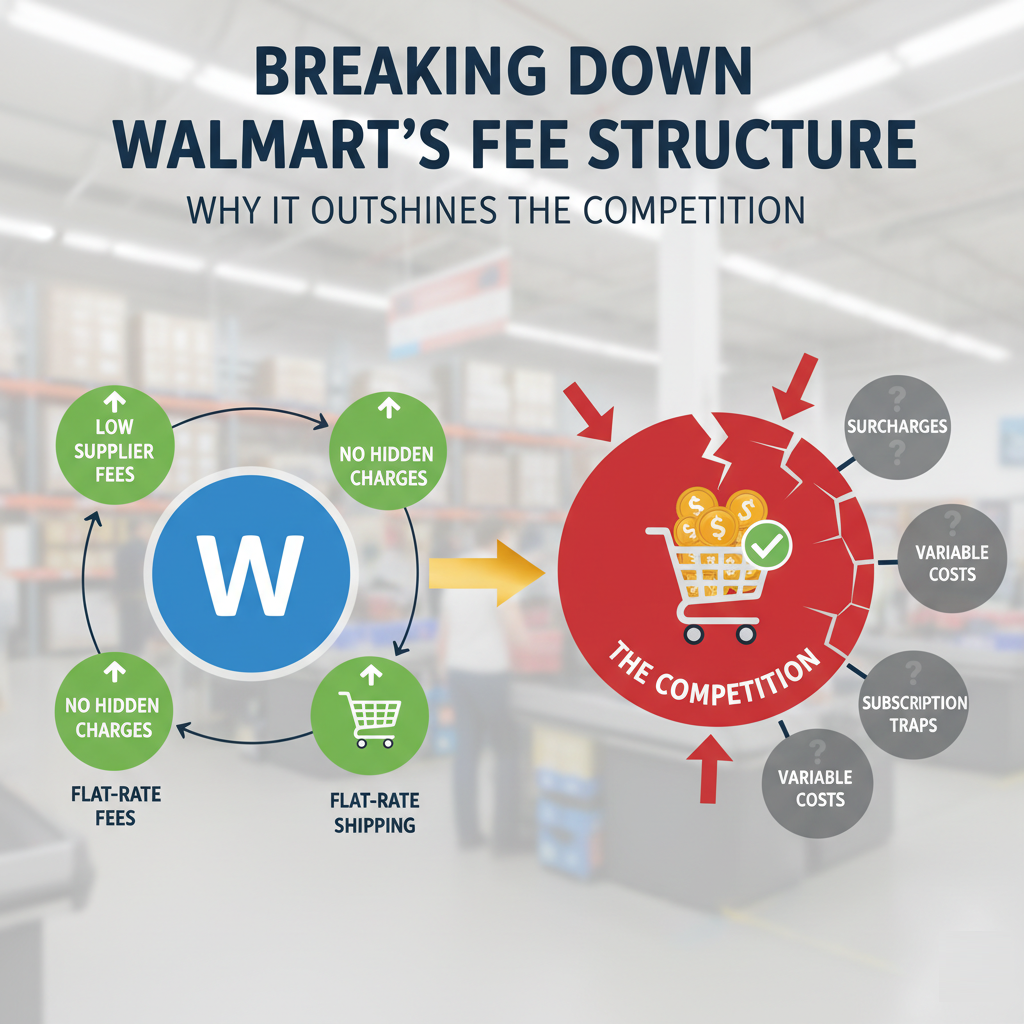
The Walmart Marketplace has quietly built a system that many sellers find refreshingly straightforward and cost-effective. But how does it really stack up against the competition?
Let’s peel back the layers and see why Walmart might just be the most profitable platform for your business.
Ever wondered if you’re leaving money on the table by sticking with the same old e-commerce giants? When it comes to selling online, understanding the fee structure is the difference between thriving and just surviving.
For years, sellers have navigated the complex and often punishing fee structures of other marketplaces.
You’re hit with listing fees, monthly subscription costs, and a dozen other charges that eat into your margins before you even make a sale.
Walmart, on the other hand, took a different path. They focused on a simple, pay-as-you-go model that has become a game-changer for businesses of all sizes.
This is a crucial part of any beginner’s guide to selling on Walmart. This post will break down exactly what you can expect to pay as a Walmart seller.
We will dive deep into the referral fees, compare them directly to competitors like Amazon and eBay, and explore the hidden costs you might not be aware of on other platforms.
By the end, you’ll have a crystal-clear picture of why Walmart’s approach isn’t just different—it’s often better.
What is Walmart Marketplace and Why Does It Matter?
So, what is Walmart Marketplace, really? Think of it as a digital extension of their massive retail footprint.
It’s an online platform that allows third-party sellers (like you!) to list and sell their products directly to the millions of customers who visit Walmart.com every day.
Unlike a traditional e-commerce platform where you build a store from scratch, the marketplace gives you instant access to a massive, built-in audience that already trusts the Walmart brand.
This model creates a powerful ecosystem. Customers get a vastly expanded product selection, while sellers gain an incredible opportunity to grow their business.
The key difference lies in the accessibility and the seller-friendly environment that Walmart has cultivated. They are actively recruiting sellers to diversify their offerings, making it an ideal time to get started.
For anyone looking to learn how to sell products on Walmart, understanding this foundation is the first step. The rise of Walmart Marketplace is a direct challenge to the established order.
It offers a compelling alternative for sellers who feel squeezed by the ever-increasing costs and competition elsewhere.
By leveraging their logistics, customer base, and brand recognition, Walmart has created a platform that’s not just a viable option but, for many, a superior one.
The Core of Walmart’s Fee Structure: Simplicity Wins
Let’s get straight to the point: what will it cost you to sell on Walmart? The beauty of their system lies in its simplicity. There are no setup fees, no monthly subscription fees, and no listing fees.
You read that right. You only pay when you make a sale. This is a massive advantage, especially for new sellers or those testing the waters with new products.
The only fee you’ll encounter is a referral fee. This is a percentage of the product’s selling price, which varies depending on the product category.
The fee is calculated on the total sales price, including shipping, but excluding taxes collected through Walmart’s tax services.
Here’s a quick breakdown of what this means for you:
- No Upfront Risk: You can list your entire catalog without spending a dime. This lowers the barrier to entry significantly and allows you to experiment without financial pressure.
- Predictable Costs: Since you only pay a percentage of what you sell, your costs scale directly with your revenue. There are no surprise monthly bills to throw your budget off track.
- Transparency: Walmart is very clear about its referral fee percentages. You can easily find the rates for each category and calculate your potential profit margins before you even list an item.
This straightforward approach is a breath of fresh air in an industry often clouded by complex and confusing fee schedules.
It allows sellers to focus on what they do best: sourcing great products and serving customers, which is a core lesson in how to sell in Walmart.
A Look at Referral Fees by Category
The referral fee is the only charge you need to worry about, so let’s break it down. The percentage Walmart takes depends entirely on the type of product you’re selling.
The rates are competitive and are often lower than what you’d find on other major marketplaces.
For example, the “Apparel & Accessories” category has a referral fee of 15%, while the “Consumer Electronics” category is at 8%.
Let’s look at a practical example. Suppose you sell a t-shirt for $20, and the shipping cost is $5. The total sale amount is $25.
In the Apparel category (15% fee), Walmart would take a referral fee of $3.75 ($25 * 0.15). That’s it. No other hidden charges.
Here’s a snapshot of the fees for some other popular categories (as of late 2025):
- Baby: 8% for items priced at or below $10, and 15% for items priced above $10.
- Books: 15%
- Electronics: 8%
- Furniture & Decor: 15%
- Grocery: 8%
- Health & Personal Care: 15%
- Pet Supplies: 15%
Having this information upfront allows you to price your products competitively while ensuring healthy profit margins.
This clear-cut calculation makes financial planning much simpler when you start selling on Walmart, and this transparency is a cornerstone of the seller experience.
In fact, this is a key part of understanding the Walmart fee structure for sellers and Walmart seller fees.
How Walmart Stacks Up: A Head-to-Head Fee Comparison
Now for the main event: how does Walmart’s fee structure compare to the biggest player in the game, Amazon? While both are incredible platforms, their approaches to seller fees are worlds apart.
This comparison is essential for anyone considering dropshipping from Walmart to Amazon or vice versa. Amazon has two selling plans: Individual and Professional.
The Individual plan charges $0.99 per item sold, while the Professional plan costs a flat $39.99 per month, regardless of how many items you sell.
On top of that, Amazon also charges a referral fee, which typically ranges from 8% to 20%, and in some categories, can go as high as 45% (like for Amazon Device Accessories).
Let’s break it down with an example. Imagine you sell 100 widgets a month at $15 each.
- On Walmart: Your referral fee (let’s assume 15%) would be $2.25 per widget. Your total fees for the month would be $225 (100 * $2.25). This reflects the transparent Walmart seller fees model.
- On Amazon (Professional Plan): You’d pay the $39.99 subscription fee plus the referral fee. Assuming the same 15% fee, your total cost would be $264.99 ($39.99 + $225). This reflects the transparent Walmart seller fees model.
While the difference in this single scenario might seem small, it adds up quickly. For sellers with a large number of listings but slower sales velocity, Walmart’s “no monthly fee” model is a clear winner.
You aren’t penalized for simply having your products available. This makes Walmart an excellent choice for businesses looking to expand their reach without committing to fixed monthly costs.
This makes Walmart an excellent choice for businesses looking to expand their reach without committing to fixed monthly costs—especially when evaluating the full cost to sell on Walmart marketplace.
What About eBay?
eBay is another major competitor, but its fee structure can be even more complex. eBay charges two main types of fees: an insertion fee (a fee to list your item) and a final value fee (a percentage of the total sale amount).
While sellers get a certain number of free listings per month, you have to pay for more.
The final value fee on eBay is generally between 12% and 15% for most categories, but it’s calculated on the total amount of the sale, including shipping and sales tax.
This can make it slightly higher than Walmart’s fee in practice. Plus, you have to contend with optional listing upgrade fees and fees for using services like PayPal.
The bottom line is that Walmart offers a level of simplicity and predictability that is hard to find elsewhere.
By eliminating monthly subscriptions and listing fees, they have created a seller-centric platform that prioritizes shared success.
Sellers no longer need to worry about hidden Walmart seller account fees, Walmart seller central fees, or mysterious Walmart slotting fees—because Walmart doesn’t charge them.
Are you tired of juggling complex fees and unpredictable costs on other platforms? It might be time to see how much you could save by switching to Walmart.
Unlike Amazon, Walmart does not have Walmart FBA fees—though it does offer Walmart Fulfillment Services (WFS) with its own transparent Walmart fulfillment fees.
And while some sellers search for “Walmart seller fees 2021” or “Walmart seller fees 2022”, the truth is Walmart has maintained a remarkably stable and fair Walmart fee structure for sellers over the years.
Quixess offers seamless integration and Walmart dropshipping automation to make the transition effortless. Schedule a free consultation today to see how we can optimize your e-commerce strategy!
Beyond Fees: The Hidden Benefits of the Walmart Ecosystem
While the fee structure is a major draw, the advantages of selling on Walmart go much deeper.
The platform offers a suite of tools and programs designed to help sellers succeed, creating an environment that fosters growth rather than just transactions.
One of the biggest perks is access to Walmart Fulfillment Services (WFS). Similar to Amazon’s FBA, WFS allows you to store your inventory at Walmart fulfillment centers.
When a customer places an order, Walmart picks, packs, and ships it for you. They also handle all customer service and returns for WFS orders.
This is a game-changer for sellers who want to offer fast, reliable shipping without the logistical headache. Products fulfilled by WFS also get “Fulfilled by Walmart” tags, which increases visibility and trust.
Furthermore, Walmart provides sellers with powerful advertising tools. With Walmart Connect, you can run sponsored product campaigns to boost your listings’ visibility in search results and on product pages.
This allows you to strategically target shoppers and drive more traffic to your products right on the platform where they are making purchasing decisions.
This allows you to strategically target shoppers and drive more traffic to your products right on the platform where they are making purchasing decisions—without extra Walmart Marketplace seller fees beyond the standard Walmart Marketplace referral fee.
Integrating for Success: The Power of Automation
To truly capitalize on the Walmart opportunity, automation is key. Managing inventory, orders, and listings across multiple ecommerce platforms can be overwhelming.
This is where a solution like Walmart dropshipping automation becomes invaluable.
By using an integrated service, you can:
- Sync Inventory in Real-Time: Avoid overselling by automatically updating your stock levels across all channels the moment a sale is made on Walmart.
- Automate Order Fulfillment: Whether you’re using WFS or fulfilling orders yourself, automation can route orders, generate shipping labels, and update tracking information without manual intervention.
- Optimize Listings: Easily manage and optimize your product listings to meet Walmart’s guidelines and improve your search ranking.
This level of integration transforms your selling process from a reactive, time-consuming task into a streamlined, efficient operation.
It’s the secret weapon that allows you to scale your business on Walmart effectively. This is also a critical consideration for anyone thinking about how to start an online store without inventory.
A Beginner’s Guide to Selling on Walmart: Getting Started
Feeling inspired to start selling on Walmart? The process is more accessible than you might think. Walmart has a straightforward application process, but they are selective.
They prioritize professional sellers who have a proven track record of excellent customer service and high-quality products.
Here’s a simplified overview of the steps involved in how to sell on Walmart online store:
- Application: You’ll start by completing an online application. You’ll need to provide details about your business, such as your US Business Tax ID, planned integration methods, and information about your product catalog.
- Approval: The Walmart team will review your application. They look for experienced e-commerce sellers with a history of success on other platforms. This vetting process helps maintain the quality and integrity of the marketplace.
- Onboarding: Once approved, you’ll complete the registration process, which includes setting up your seller profile, payment information, and shipping options.
- Listing and Integration: Next, you’ll list your products. You can do this manually, via a bulk upload using spreadsheets, or—the most efficient method—by integrating with a solution provider like Quixess. Integration automates the entire process, making it much faster and less prone to errors. You’ll never encounter surprise walmart fees for sellers during this process—because there aren’t any.
Go Live! After you’ve listed your products and completed the final review steps, you can request to launch your account. Once you’re live, your products will be visible to millions of Walmart customers.
This process ensures that both sellers and customers have a positive experience on the platform. By focusing on quality, Walmart builds a marketplace that people trust, which ultimately benefits everyone involved.
Why Walmart’s Fee Structure is a Win for Sellers
In the competitive world of e-commerce, every percentage point matters.
Walmart has clearly positioned itself as a seller-friendly platform by creating a fee structure that is simple, transparent, and incredibly cost-effective.
By eliminating monthly fees and offering competitive referral rates—what many sellers refer to as the Walmart commission rate—they have removed the financial barriers that can stifle growth on other platforms.
But the advantages don’t stop at the fees.
With access to programs like WFS, powerful advertising tools, and a massive built-in customer base, Walmart provides a comprehensive ecosystem for sellers to thrive.
When combined with the power of e-commerce integrated customer service and automation, the potential for growth is immense.
Whether you’re a seasoned seller looking to diversify your channels or a newcomer seeking a platform with a lower barrier to entry, Walmart deserves your serious consideration.
Their model is built on a simple premise: they only succeed when you succeed. In an industry where sellers often feel like just another number, that partnership approach makes all the difference.
The simplicity and fairness of the Walmart Marketplace are undeniable—and so is the value of its straightforward Walmart Marketplace referral fee.
Important Note for Sellers: While Walmart’s core marketplace model is fee-transparent, third-party services like Walmart Money Center—used by some sellers for payment processing or cash management—may carry separate Walmart money center fees. These are unrelated to your product sales but worth tracking if you use Walmart’s financial services.
Ready to stop paying unnecessary fees and start maximizing your profits? Take the next step in your e-commerce journey.
Contact Quixess today to learn how our powerful automation tools can help you seamlessly launch and scale your business on the Walmart Marketplace.
Plus, experience our premium – level service for free for the first 6 months. After this beta period, you’ll enjoy a 10% discount on any subscription level you choose, ensuring ongoing value.
Your future in e-commerce starts now!