
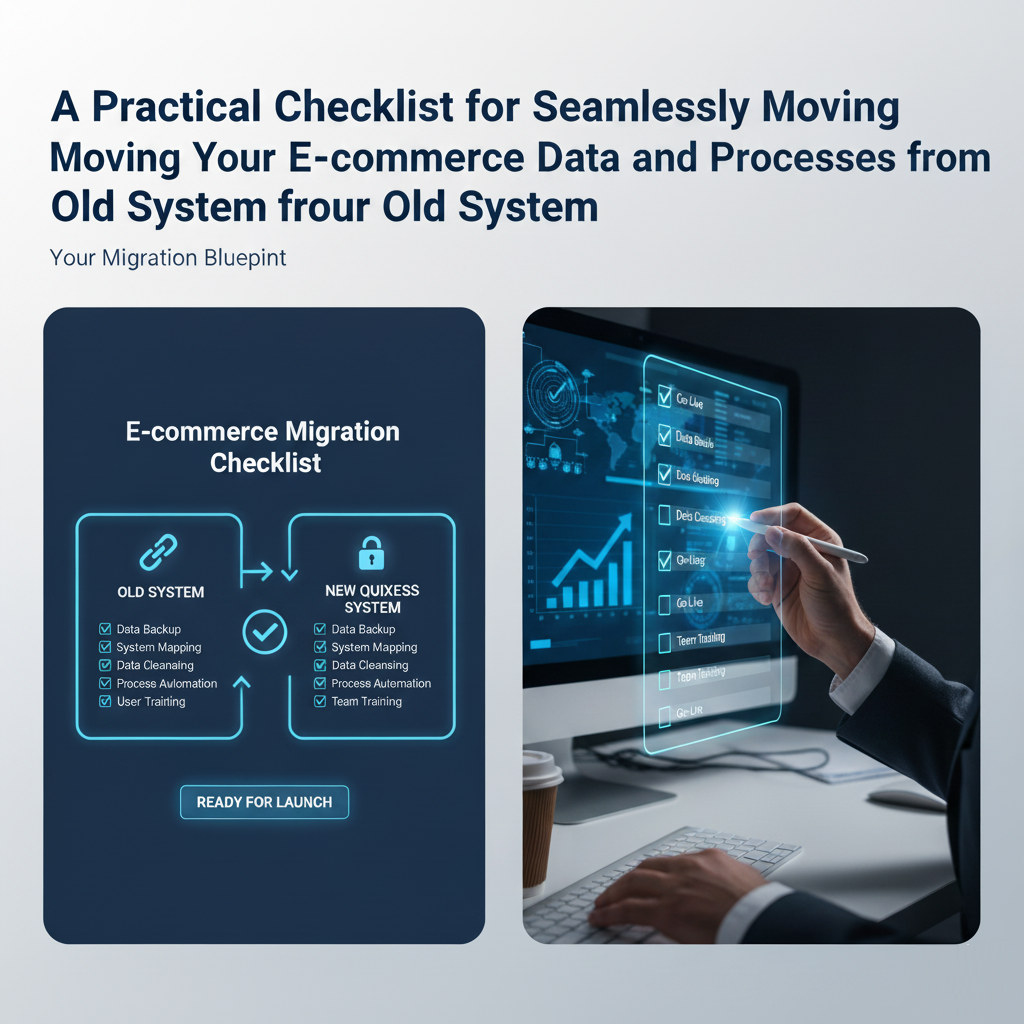
Moving your E-commerce Data and Processes can feel like trying to pack up an entire warehouse of invisible stuff. It’s overwhelming, stressful, and fraught with potential for forgotten essentials.
Have you ever attempted to migrate complex operational information only to find critical customer histories or inventory details lost in the digital shuffle? Quixess E-commerce Automation understands this challenge.
We know the high-stakes reality: a smooth transition means continued sales and happy customers, while a bumpy one can halt your business dead in its tracks.
This comprehensive, practical checklist is your roadmap to a seamless, stress-free move.
Auditing Your Current E-commerce Data and Processes
Before you even think about hitting the ‘export’ button, you must take a rigorous look under the hood of your existing operation.
What exactly are you moving? You must not just transfer files; you must transition complex, interconnected E-commerce Data and Processes.
Data Audit: What Needs to Come Over?
A thorough audit saves untold hours of headache later. Think of your data in buckets.
- Customer Records: This is arguably your most vital asset. It includes names, addresses, purchase history, saved payment methods, and loyalty program status. Critical, sensitive information like customer service tickets and interaction notes are often overlooked. E-commerce data and processes examples abound here, showing that losing this context cripples personalized marketing.
- Product Inventory: Beyond SKU numbers and stock levels, you must move detailed product descriptions, high-resolution images, video links, pricing tiers (wholesale, retail, sale), and supplier details. Are your current product attributes standardized? Poor data hygiene will plague your new system.
- Order History and Financials: Every sale, refund, and chargeback must be accounted for. This is crucial for accounting, taxes, and forecasting. Furthermore, maintaining the link between the order history and the customer is essential for lifetime value analysis.
Process Assessment: What are Your Workflows?
Data is static; processes are how you use that data to make money. Identifying and documenting your core E-commerce Data and Processes is non-negotiable.
- Fulfillment Workflow: How is an order currently picked, packed, shipped, and tracked? Are there manual steps that Quixess E-commerce Automation can eliminate? Mapping this out is necessary for configuring the new system’s logistics integration.
- Marketing and Sales Funnels: Where are your leads captured? How do they move through your email campaigns? Do your promotions automatically apply discounts at checkout? These automations are part of your established e-commerce data and processes notes that must be rebuilt.
- Customer Service Integration: How does a support ticket connect to an order? Losing the thread between e-commerce integrated customer service and purchase data is disastrous for resolution times. Understanding the importance of customer service in ecommerce means ensuring a smooth transition of these support processes.
Phase One: Technical Preparation and Data Cleansing
Once you know what you have, you can plan how to move it. This phase is heavy on technical detail and requires meticulous attention to data quality.
Mapping the Data Migration
Your old system’s data structure will almost certainly not perfectly match your new platform, like Quixess E-commerce Automation. This is where data mapping becomes your best friend.
- Source Field $\rightarrow$ Destination Field: Create a spreadsheet that details exactly where each piece of old data will reside in the new system. For example, Old System’s ‘Customer_ID’ must map to New System’s ‘User_Primary_Key’.
- Data Transformation Rules: Sometimes, data needs to change format. A price stored as “$19.99 might need to become the numeric value “19.99”. Document every transformation rule necessary for the new system to read the E-commerce Data and Processes correctly.
The Imperative of Data Cleansing
Moving bad data is like moving rotten food—it spoils the whole batch. This is your chance for a fresh start.
- Deduplication: Are there 50 different entries for ‘123 Main St, Anytown’? Merge them. Duplicate customer records inflate your metrics and complicate personalized service.
- Normalization: Ensure every entry in a specific field uses a consistent format. Standardize abbreviations (e.g., always use ‘Street’ instead of ‘St.’).
- Removal of Redundancy/Obsolete Data: Do you really need order data from 15 years ago? Archiving truly ancient or irrelevant E-commerce Data and Processes lightens the load and speeds up the new system. This step is a critical part of pre-migration e-commerce data analysis project.
Actionable Checklist: The Migration Steps
With clean data and a clear map, the move itself can be systematically executed. This checklist breaks down the migration into manageable, sequential steps.
Step A: System Setup and Integration
Before data can flow, the pipes need to be laid. A fundamental advantage of choosing a provider like Quixess E-commerce Automation is the robust API and pre-built integrations, but they still need configuring.
- Install and Configure Core Integrations: Set up payment gateways, shipping providers (like FedEx/UPS/USPS), and inventory management tools. These tools handle key E-commerce Data and Processes for fulfillment and finance.
- User Account Setup: Create and assign roles for all team members (Admin, Fulfillment, Marketing, etc.). Security permissions must be correctly set up before sensitive data is loaded.
Step B: The Data Migration Sequence
Data should be migrated in an order that respects dependencies. You can’t assign an order to a customer who doesn’t exist yet!
- Products/Catalog: Move all product details first. This provides the foundation.
- Customers/Users: Migrate the user accounts and profiles.
- Historical Orders: Link the orders to the now-existing products and customers. This is the trickiest step, requiring careful matching of IDs.
- Financials/Transactions: Ensure all accounting data aligns with the migrated orders.
Is the complexity of mapping your legacy system’s E-commerce Data and Processes giving you nightmares? Stop wasting time on manual data transformation. Contact Quixess E-commerce
Automation today for a free consultation on our seamless migration service, designed to get your business running faster with zero data loss. We make moving your complex E-commerce Data and Processes simple.
Phase Two: Testing, Validation, and Going Live
The move isn’t complete until you’ve verified that everything works in the new environment. Validation is key.
The Crucial Post-Migration Audit
Treat the new system as guilty until proven innocent. You must systematically verify the integrity of the migrated E-commerce Data and Processes.
- Sample Checks: Pick a random selection of:
- 10 customer accounts: Check their address, order history, and loyalty points.
- 10 products: Check pricing, inventory levels, and images.
- 10 recent orders: Check that the total, items, and shipping details match the old system exactly.
- Functionality Tests: Run a few “test orders” through the live system. Do payments process correctly? Does the order automatically push to your fulfillment system? This validates the process flows that rely on the E-commerce Data and Processes.
The Go-Live Plan and Cutover
The cutover is the moment you switch off the old system and rely solely on the new one. This must be planned meticulously, often done during an overnight or low-traffic window.
- Final Sync: Perform one last, incremental sync of all transactional E-commerce Data and Processes (like new orders, customer sign-ups) that occurred during the main migration window.
- DNS Update: Direct your website’s domain name system (DNS) to the new server/platform.
- Team Training and Monitoring: Ensure your team is fully trained and ready to field questions on the new platform. For the first week, monitor all core processes—checkout, fulfillment, support—with hyper-vigilance.
Beyond Data: Optimizing Your E-commerce Data and Processes with Quixess
A new platform like Quixess E-commerce Automation isn’t just a place to store old files; it’s an opportunity to implement smarter, faster E-commerce Data and Processes.
Considering the current ecommerce platforms landscape, automation isn’t optional; it’s a competitive necessity.
Leveraging Automation for Growth
Your migration should also be a launchpad for optimization. What are you now capable of?
- Personalized Marketing: Use the centralized and clean customer data to segment users based on purchase history, abandonment rate, and value. Automate email sequences based on these segments.
- Inventory Automation: Set up automated reorder points and alerts. Instead of manually checking stock, allow the system to predict demand using past sales data—a key e-commerce data analysis project feature.
- Seamless Customer Service: Integrate all communication channels (email, chat, social) into one platform linked to your migrated order and customer history. This makes e-commerce integrated customer service a reality, dramatically reducing resolution time.
Understanding the E-commerce Landscape
To truly succeed, you must understand the broader context. What is E commerce? It is not just a digital storefront; it is a complex ecosystem.
Migrating your E-commerce Data and Processes is your entry point to capitalizing on the massive shift toward digital retail.
Whether you run a B2C, B2B, or C2C model—the types of e commerce with examples ranging from Amazon to Etsy demonstrate that the underlying need for efficiency is universal.
An effective platform maximizes your return on data.
The modern e-commerce platform demands that you treat your data as a living, breathing asset. Don’t just move your business; use this opportunity to refine, automate, and accelerate it.
Final Step: Secure and Sustainable Operation
A successful migration ensures security and sets the stage for future growth.
Security and Compliance
Your E-commerce Data and Processes contain sensitive information. The new system must be compliant from day one.
- PCI Compliance: For payment data, adherence to the Payment Card Industry Data Security Standard is mandatory.
- Privacy Regulations: Ensure your customer data handling complies with regulations like GDPR or CCPA, depending on where your customers are located.
Thinking Long-Term
Finally, plan for scale. Your new system and processes should accommodate future growth without breaking.
Does the ecommerce platform you’ve chosen have the capacity to handle a 5x increase in traffic and data volume? With Quixess E-commerce Automation, the answer is yes.
Moving your E-commerce Data and Processes is a heavy lift, but with this detailed checklist, it becomes an achievable project with minimal disruption.
Don’t let fear of the unknown hold your business back. Embrace the transition as a chance to upgrade your entire operation, improving efficiency and customer satisfaction.
Ready to stop worrying about manual data transfers and start focusing on growth?
Quixess E-commerce Automation is the dedicated partner you need for a smooth, risk-free migration of all your sensitive E-commerce Data and Processes.
Click here to schedule your personalized migration strategy session and take the first step toward a fully automated future.