
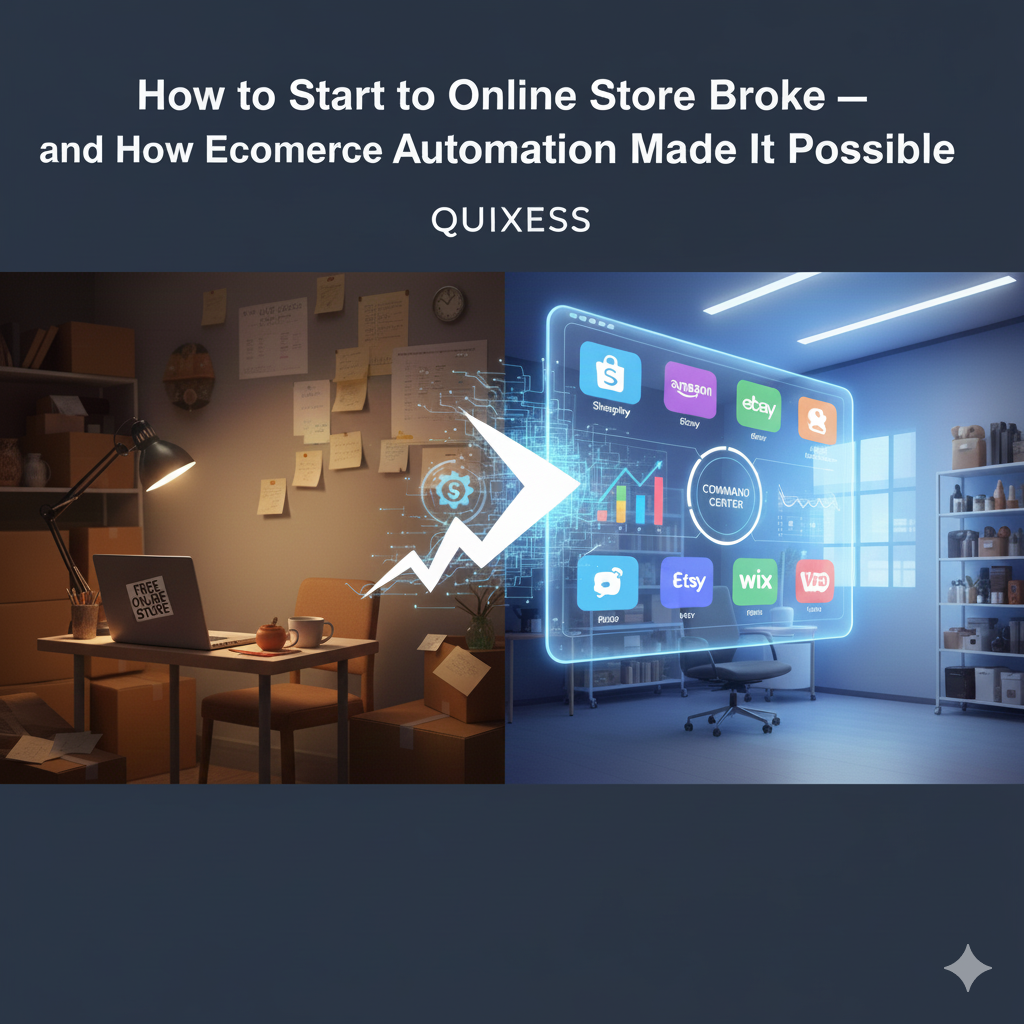
This blog post is about how to start an online store, and how automation makes it possible. Jane stared at the glow of her laptop screen in her tiny living room. She had poured her energy, her creativity and the last bit of her savings into launching an online store.
Her products were good. Her ideas were solid. Her passion was real. But the exhaustion was becoming impossible to ignore.
- Every day felt like a fight to stay afloat.
- Uploading products took too long.
- Managing inventory was a guessing game.
- Customer messages kept piling up.
- And one small mistake could wipe out a week of progress.
Jane was not failing because she lacked talent. She was drowning because she was doing everything manually.
Then one late night, after yet another order mistake forced her to issue a refund she could not afford, she stumbled on a truth that changed everything:
People who start online stores with very little money succeed when they stop doing everything by hand and start letting automation work for them.
That realization was the breakthrough she needed. The moment automation stepped in, her business shifted from overwhelming chaos to manageable growth.
Why Starting Broke Is Not a Barrier When Automation Is Involved
Many new entrepreneurs believe they need money to compete. In reality, they need systems. Automation cuts costs, saves time, and eliminates the mistakes that destroy new businesses.
Here is how automation empowers online sellers who are starting with limited resources.
1. Sell Products Without Paying for Stock Upfront
Automation connects your product catalog directly to suppliers, allowing you to list items instantly and only purchase inventory after a customer buys.
- No upfront investment.
- No boxes filling your room.
- No risk of buying items that do not sell.
2. Instant Price Updates That Protect Your Profit
Manual pricing leads to lost revenue and constant changes. Automation makes it simple:
- Prices adjust across platforms instantly
- You can set your desired profit margins
- Supplier price changes are applied automatically
Your store stays competitive without constant monitoring.
3. Orders Process Themselves Without Your Intervention
Automation ensures that every order moves smoothly:
- Customer places an order
- Supplier receives accurate information
- Shipping begins without delays
- Tracking updates are sent automatically
Mistakes drop. Processing time shrinks. Customers stay happy.
4. Real Time Notifications Build Trust with Customers
Automated updates reassure buyers through:
- Order confirmations
- Shipping alerts
- Delivery updates
Even if you are running your business from a small apartment, automation helps your store look professional and reliable.
5. One Product Upload Works Everywhere
With automation, you do not need to upload products repeatedly across multiple platforms. You update once and the system syncs everything.
- Website
- Social platforms
- Marketplaces
Consistency becomes effortless.
What Jane Struggled With, You Can Avoid
Jane’s early challenges are familiar to anyone who starts an online store with limited funds. But her turnaround also proves something important:
Smart systems remove the limitations that money would have solved.
Automation does not just save time. It saves businesses that would have failed under the weight of manual work. It gives small starters the power, control and efficiency that larger brands use every day.
Starting broke does not mean starting weak. Not when automation is part of the plan.
About Starting Broke and Automating – FAQs
Before diving into the details, here is a quick FAQ to help clarify the most common questions entrepreneurs have when starting an online store with limited funds—and how automation makes the process easier, faster, and more profitable.
Getting Started & Initial Costs
To make the journey clearer for anyone starting out with little capital or limited tools, here is a breakdown of the most important questions new online sellers ask—along with practical answers that show how automation reduces costs, saves time, and prevents the mistakes that often derail new businesses.
Q1: I have very little startup capital. Can I really start an online store for free or almost free?
Absolutely. As the post mentions, the initial barriers to entry are gone. You can leverage a free online store builder or a free online store maker (like free tiers of certain platforms) to get your digital doors open and your first products listed without major investment. The key is to start small, validate your product idea, and then strategically invest in solutions (like automation) as soon as you generate revenue.
Q2: At what point do I need to stop using a free online store creator and invest in automation software?
The transition point is not based on revenue, but on time spent and risk tolerance. If you find yourself spending more than 3-4 hours per week just manually checking inventory, copying tracking numbers, or listing the same product across different sites (like Etsy and Amazon), it’s time to automate. The cost of your time and the risk of an expensive oversell far outweigh the cost of the automation software.
Q3: What exactly is an “oversell” and why is automation critical to preventing it?
An oversell happens when a customer purchases an item that is actually out of stock. For example, you have 1 unit left; a customer buys it on your Shopify site, but before you can manually update the inventory on eBay, another customer buys it there. This results in a canceled order, a disappointed customer, and potentially a damaged seller rating. Automation provides real-time, instantaneous synchronization of inventory across all your channels, eliminating this risk.
Multi-Channel Selling & The Automation Solution
As your online store grows, selling on just one platform quickly becomes limiting. Customers shop across multiple marketplaces, and meeting them where they already are is essential. This section explains why multi-channel selling matters—and how automation makes it manageable, efficient, and scalable.
Q4: Why can’t I just stick to one platform, like my free web shop builder, to keep things simple?
You certainly can, but it severely limits your growth. Shoppers are highly fragmented. Sticking to one platform means you miss out on Amazon’s massive convenience-seeking audience, Etsy’s unique/handmade buyers, and eBay’s global reach. To truly scale and build a resilient business, you must be present across all major shopping destinations, which is what necessitates a single, centralized management system.
Q5: What does it mean to “Sell across Shopify, Amazon, Ebay, Wix, Etsy, Square, and Woo all in one dashboard?”
It means all the administrative tasks—product listing updates, pricing changes, inventory counts, and order fulfillment—are handled through one single piece of software, rather than requiring you to log into seven separate portals. This single dashboard acts as the “source of truth” for your entire business.
Q6: Does automation mean I lose control over platform-specific requirements, like Amazon’s fulfillment rules?
No, the opposite is true. A powerful integration solution acts as a translator. It allows you to build a master product listing once, and then it intelligently maps that data to meet the specific requirements of each platform (e.g., specific tags for Etsy, bullet points for Amazon). Crucially, it ensures that your fulfillment data (like tracking numbers) is sent back to Amazon in the precise format they require to maintain your seller health score.
Time & Profit Calculation
Time is one of the most valuable resources in any online business, especially when you’re starting with limited funds. This section breaks down how automation directly impacts your workload and your bottom line—showing you exactly why efficiency matters as much as revenue.
Q7: The post mentions recovering 13 hours of work per 100 orders. What should I do with that recovered time?
That recovered time should be reinvested into high-value, growth-oriented tasks that only you, the entrepreneur, can do. This includes:
- Marketing & SEO: Driving traffic to your stores.
- Product Development: Sourcing new items or creating unique products.
- Customer Engagement: Building loyalty and community.
- Strategic Planning: Analyzing sales data and market trends.
Q8: Is the automation platform complicated to set up if I started with a basic free online shop maker?
The best automation solutions are designed for ease of use, often featuring pre-built, “one-click” connections to all the major sales channels. While there is an initial learning curve for setting up your product data mapping, the goal is to make the move from your single-channel setup to a multi-channel hub as straightforward as possible.
The Next Step: Making the Investment
The decision to search for a free online store creator was the start of something big. The next step is the commitment to efficiency and centralization.
The story of how I started an online store is really a story about smart decisions, and the best decision I ever made was automating my sales flow.
It transitioned the business from a chaotic, time-sucking venture into a streamlined, high-growth enterprise.
Ready to stop the manual juggling act and start selling smarter across all your channels?
Scale Smart, Not Hard
We are here to help you make that shift easy and affordable.
Enjoy a 10% discount on any subscription level you choose, ensuring ongoing value.