
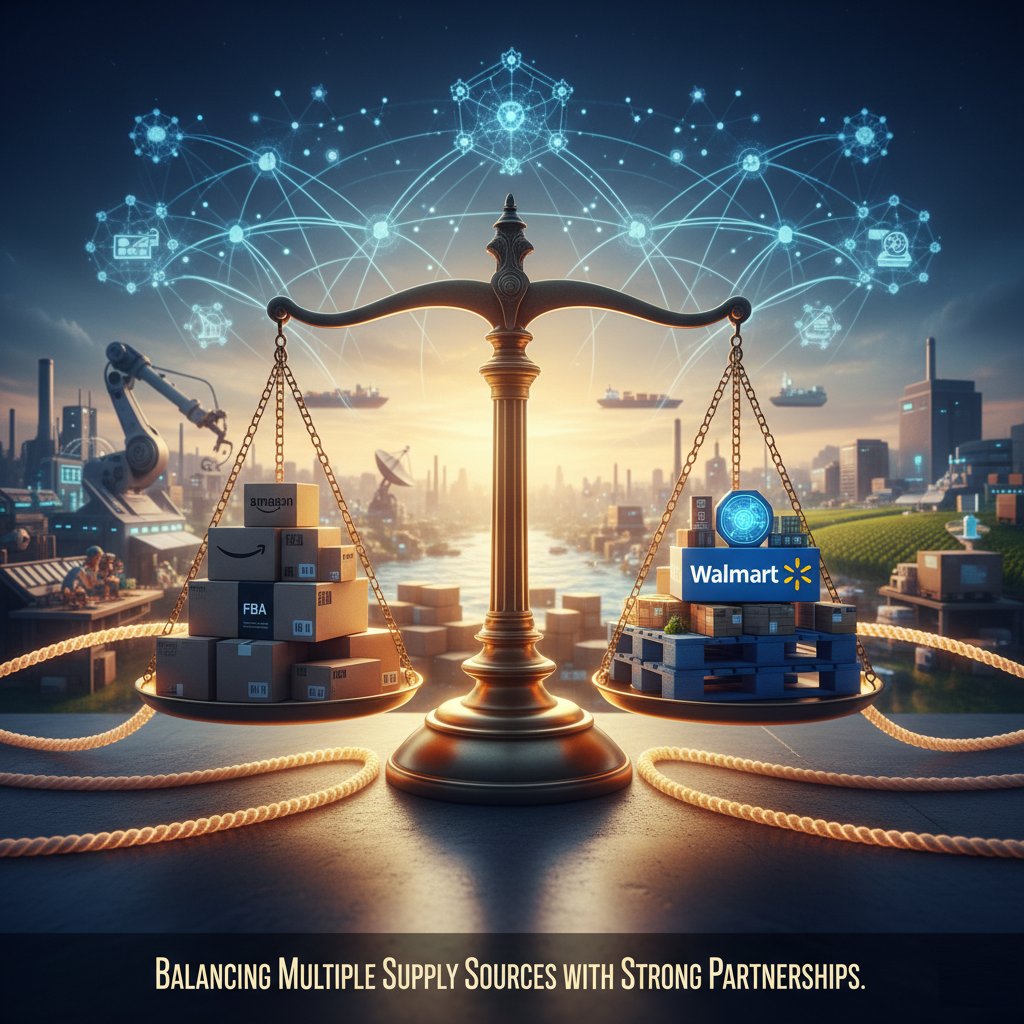
Thus, the highest level of success with multiple supply sources must be achieved in a complex market. The core focus of every expanding e-commerce enterprise involves the management of its procurement.
This examination is essential. Reliance on a single supply chain is a risk that cannot be ignored today, highlighting the critical debate of multiple suppliers vs single suppliers.
When an organization begins to scale, diversifying the sources from which its products are acquired becomes critically important for continued operation.
Therefore, careful consideration is given to managing these multiple supply sources effectively.
The Imperative for Multiple Supply Sources
The global market today is characterized by frequent disruptions. Consequently, supply chain resilience is now the main priority for successful businesses.
The long-held practice of single sourcing is now understood to be far too risky. Natural disasters, geopolitical events, and unexpected factory shutdowns can swiftly halt a business that relies on only one supplier.
Therefore, a shift toward a more protected model is being observed across the entire industry, which relies on multiple supply sources.
multiple supply sources examples are seen everywhere. This includes major tech companies and small online shops.
A producer of custom apparel, for instance, might use one vendor for blank t-shirts and another for specialized printing inks. This is a common form of multi-sourcing, and a classic multi sourcing example.
This is a common form of multi-sourcing. It ensures that if one vendor faces a challenge, the other can provide a temporary solution. The risk of total failure is reduced significantly by adopting multiple supply sources.
Core Sourcing Strategies
A few distinct strategies are used in this area. Dual sourcing, for example, is where exactly two suppliers are chosen for the same item. In this scenario, 60% of the volume might be assigned to a primary vendor.
The remaining 40% is given to a backup. The value of multiple supply sources is immediately visible here. Smarter tools are required to coordinate the split orders and track performance accurately.
Furthermore, the goal is always resilience, which is supported by multiple supply sources.
Multiple sourcing is the strategy where a business uses more than two suppliers for the same or similar goods. This provides the highest level of protection against disruption.
To understand the multi sourcing definition, it is the practice of contracting with several suppliers for a single component or finished product. This provides the highest level of protection against disruption.
However, this diversity of suppliers also means that the administrative burden is increased substantially. The need for advanced technology to manage the complexity of multiple supply sources becomes the central consideration.
Conversely, a few suppliers strategy is often employed when a product is highly complex or specialized. In this instance, a business might narrow the field down to a small, select group of high-quality partners.
Close partnerships are formed with these few, with a strong focus on shared planning and information.
The stability offered by this tight relationship is considered more valuable than the extreme flexibility of general multi-sourcing.
The strategic benefit of multiple supply sources is thus proven in how well they support the deep integration required by this approach.
Analyzing Multiple Sourcing Advantages and Disadvantages
Multiple sourcing advantages are numerous and important for the future of any e-commerce venture that utilizes multiple supply sources.
First, the most apparent benefit is the mitigation of risk. When one supplier is unable to deliver, the flow of goods is maintained by another.
This continuity prevents stockouts, protects sales revenue, and maintains customer loyalty, which is key to managing multiple supply sources.
Second, the competitive environment is fostered among suppliers. Suppliers are generally kept honest on pricing and quality. This is because they know a business has alternatives available via multiple supply sources.
This continuous pressure ensures that the buyer always receives the best possible value for the materials or products acquired. Consequently, better terms are often negotiated over time.
The Trade-offs of Diversification
However, the disadvantages of multiple sourcing are substantial and cannot be ignored. The most significant drawback is the increase in complexity.
More administrative effort is required to manage multiple contracts, quality checks, and communication channels across multiple supply sources.
This administrative overhead can offset any cost savings that are gained through competition. This complexity makes the discussion of necessary technology for multiple supply sources a required one.
Furthermore, volume discounts often become harder to achieve. When large orders are split among several suppliers, the volume given to any single vendor is decreased.
Thus, the buyer loses some leverage to negotiate the lowest unit price. This is a critical factor that must be weighed against the benefit of reduced risk provided by multiple supply sources.
Ultimately, the calculation of the total value of multiple supply sources must account for the cost of this lost volume discount.
Quality control is also more challenging. With various suppliers, achieving uniform product standards across all incoming inventory demands rigorous inspection procedures.
A single quality lapse from one supplier can damage a brand’s reputation severely across all sales channels.
The efficiency of multiple supply sources is realized when technology is used to standardize these quality checks and track supplier performance precisely.
The implementation of multiple supply sources is, therefore, a strategic balancing act. The benefits of resilience must be carefully weighed against the costs of complexity and administration.
This is where the right technology shifts the balance in favor of the multi-sourcing approach. The best way to make multi-sourcing work is by relying on a positive framework of multiple supply sources to handle the heavy lifting.
Forging Strong Partnerships: Beyond Transactions
A successful multi-sourcing strategy is not simply about having a list of alternative vendors. In fact, it is about building strong, collaborative partnerships.
A supplier should not be viewed merely as a source of products. Instead, they should be treated as an extension of one’s own business operations. This perspective is what drives long-term success with multiple supply sources.
This close relationship is especially vital when employing a few suppliers strategy. When volumes are significant, deep integration is possible, and trust is built.
Open communication regarding sales forecasts, future product needs, and potential risks allows both parties to plan proactively. This shared visibility reduces surprises for everyone involved with multiple supply sources.
Consider a multi sourcing example where an ecommerce platform shares its predictive demand data with its top two fabric suppliers.
When a sales trend shows a spike in demand for a certain color, the suppliers are alerted immediately. They can then adjust their raw material orders.
This kind of shared data dramatically shortens lead times and enhances responsiveness. The achievement of a strong structure for multiple supply sources relies on this data sharing capability.
Moreover, these partnerships help in co-developing new products. Suppliers who are treated as partners are often more willing to invest in new tooling or specialized processes.
This may be required for a buyer’s unique product lines. This collaboration fosters innovation that is not possible in a purely transactional relationship. The benefit is felt throughout the supply chain that uses multiple supply sources.
When a deep level of trust is established, the administrative work required to manage the multiple supply sources is lessened.
This is because the need for constant supervision and excessive quality checks is reduced, which saves both time and money.
Thus, the positive impact of multiple supply sources is augmented by the reduced human effort required due to mutual trust and shared systems.
Essential Role of Smarter Tools in E-commerce
The modern e-commerce business cannot manage the complexities of multiple sourcing without powerful technology.
Smarter Tools are the engine that transforms the risk-mitigation strategy of multi-sourcing into a profitable reality. Without them, the administrative burden would be crippling and unsustainable for growth.
It is critical that the maximum benefit of multiple supply sources is leveraged across all operations.
The first major challenge that must be overcome is the ability to Sell Everywhere. Today’s customers shop across many popular e-commerce platforms, including branded websites, major marketplaces, and social media shops.
A business needs to be omnipresent. Inventory must be synchronized accurately across all channels. This is a difficult task when managing multiple supply sources.
Imagine a product is sold simultaneously on five different platforms. If stock runs out on one channel before the inventory record is updated, a disastrous oversell can occur.
This results in customer cancellations and lost loyalty. The efficiency of multiple supply sources is demonstrated by software that instantly updates inventory in real-time.
It pulls stock data from multiple supply sources and allocates it intelligently across all selling locations.
Effective e-commerce integrated customer service is another area where smarter tools are absolutely essential. When a customer contacts support, the representative must know instantly where the product was sourced.
They must also know its location and current shipping status. This is nearly impossible to track manually when dealing with multiple supply sources and fulfillment centers.
Smarter Tools bring all this data into a single, unified view. A support agent can see all sourcing details. This allows for swift, accurate, and professional customer service.
It turns a potential complaint into a positive interaction. The quick resolution of issues contributes directly to the success of using multiple supply sources.
For new entrepreneurs, the question of how to start an online store without inventory is often raised. This is possible through dropshipping or using a 3PL (Third-Party Logistics) provider.
Both rely entirely on Smarter Tools. The tool integrates the chosen ecommerce platform with the supplier or 3PL warehouse.
When an order is placed, the tool automatically routes the order to the correct supply source for fulfillment.
This reliance on automation highlights the enormous benefit of multiple supply sources. Labor that would otherwise be spent manually tracking orders is eliminated entirely.
This efficiency allows small teams to manage enormous sales volumes. This is the key to scaling rapidly. The value is undeniable when labor costs are drastically lowered by leveraging multiple supply sources.
The selection of the right ecommerce platform is paramount. The platform must offer the necessary open APIs and integration capabilities.
This allows it to connect seamlessly with supplier management, warehouse management, and all other systems. A closed, rigid platform will quickly become a barrier to adopting a robust multi-sourcing strategy.
Therefore, the choice of the platform is a foundational element in maximizing the potential of multiple supply sources.
Achieving the Benefits of Multiple Supply Sources
Calculating the benefit of multiple supply sources involves looking beyond the simple initial cost of the software. The real return is measured in risk mitigation, increased sales velocity, and massive operational efficiency gains.
The investment is seen as a necessary cost of resilience, not merely an optional expense.
First, consider the cost of stockouts. If a single source fails and a business is forced to miss 100 orders per day for a week, the revenue lost is substantial.
The benefit of multiple supply sources is realized by the single moment the tool automatically switches fulfillment from a disrupted primary source to an active secondary source.
This prevents revenue loss entirely. The tool can pay for itself many times over with a single avoided disaster.
Second, administrative cost reduction is a clear benefit. It has been estimated that a well-integrated system can reduce the time spent on manual order processing, inventory reconciliation, and tracking by up to 80%.
If several employees were required to manage the complexity of multiple sourcing, the value of multiple supply sources can be calculated by comparing the software subscription fee to the cost of those salaries.
This is often the strongest financial argument for investment.
Furthermore, dynamic purchasing optimization adds significant value. Smarter Tools are designed to monitor performance across all multiple supply sources.
If Supplier A is suddenly offering a better price, or if Supplier B’s delivery time has drastically improved, the tool can automatically adjust the purchasing allocation.
This ensures that the most cost-effective or fastest supplier is being used at any given time. This directly increases the profit margin on every sale.
The use of predictive analytics, which is included in many modern Smarter Tools, is also crucial.
This technology analyzes historical sales data, seasonal trends, and even external factors like weather to forecast demand with greater accuracy.
This superior forecasting means inventory is bought at the right time, in the right quantity. It is positioned in the right fulfillment center.
This minimizes both unnecessary inventory costs and costly stockouts. The efficacy of multiple supply sources is amplified by this reduction in carrying costs.
Conclusion: A Paradigm Shift for Quixess
The journey toward resilient and profitable e-commerce operations requires a fundamental shift in strategy. The need to balance multiple supply sources is no longer optional; it is an imperative born of global market volatility.
Consequently, these challenges are best met by forging strong, collaborative partnerships and by deploying integrated, Smarter Tools.
When managed manually, the disadvantages of multiple sourcing—namely, complexity and administrative overhead—can negate the benefits of risk reduction.
However, when the right technology is introduced, this complexity is automated and managed seamlessly across all popular e-commerce platforms.
The result is a highly agile, responsive, and profitable supply chain, which is built upon well-managed multiple supply sources
Ultimately, businesses that thrive in the current landscape are those that recognize that the highest value from multiple supply sources comes not just from saving money, but from protecting the entire revenue stream.
Ready to Gain Resilience and Increase Your Margins?
You are likely ready to move beyond manual spreadsheets and transactional supplier relationships.
The next paradigm in e-commerce requires technology that coordinates every order, every platform, and every supplier automatically.
Quixess is the platform built specifically to help you leverage the maximum benefit of multiple supply sources by seamlessly integrating your multiple supply sources with all your sales channels.
Stop risking your revenue on a single source and join the future of resilient e-commerce with Quixess.
Sign up today and claim your first 6 months FREE, allowing you to experience seamless multi-sourcing and platform integration risk-free. When you start paying, you’ll secure an additional 10% off your subscription for life.
Don’t wait—it’s time to maximize your margins and secure your supply chain.
Join the Quixess Beta Today to Receive Early Access and Exclusive Pricing!